
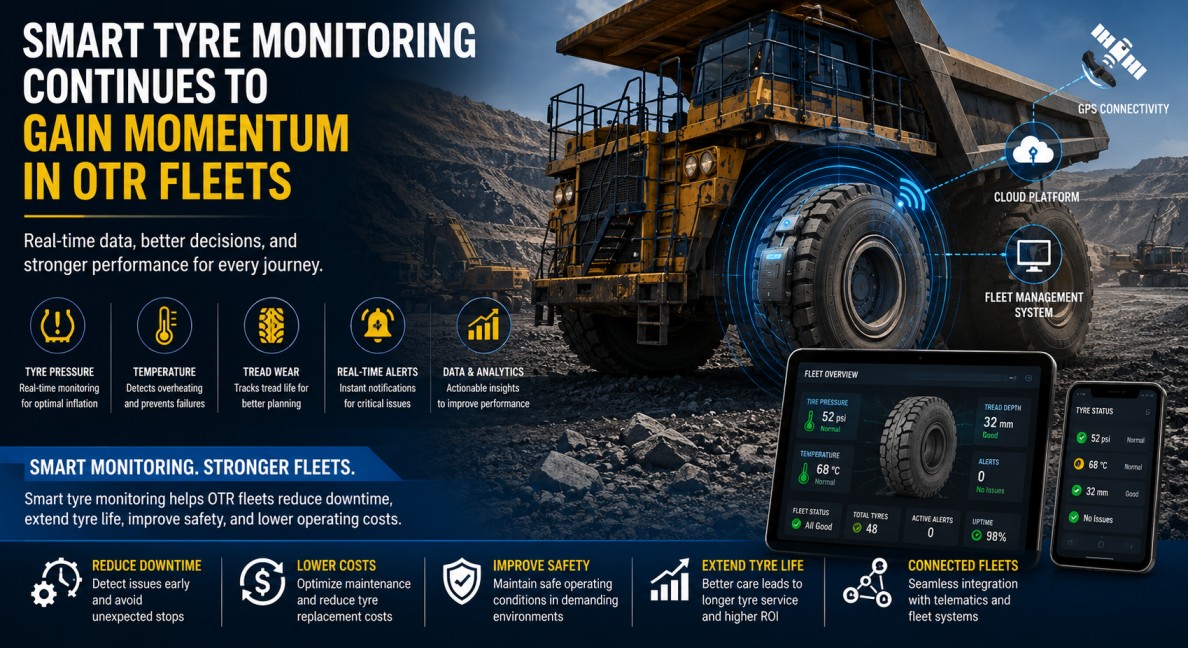
Smart Tyre Monitoring Continues to Gain Momentum in OTR Fleets
Smart tyre monitoring systems are becoming an essential technology for Off-The-Road (OTR) fleets across mining, construction, quarrying, and industrial sectors. Fleet operators are increasingly adopting Tire Pressure Monitoring Systems (TPMS), IoT sensors, and telematics to monitor tyre pressure, temperature, load, and tread wear in real time. These technologies help improve equipment uptime, reduce maintenance costs, and extend tyre service life, making smart tyre management a growing trend throughout 2026.
Market Growth by Numbers
- Growing adoption: More mining and construction companies are integrating smart tyre monitoring into fleet management systems.
- Reduced downtime: Real-time tyre monitoring helps identify issues before they result in costly equipment failures.
- Improved tyre lifespan: Continuous monitoring optimizes inflation pressure and reduces irregular wear.
- Fleet digitalization: Connected tyre technologies are becoming a standard feature in modern heavy equipment fleets.
- Operational efficiency: Data-driven tyre management helps lower maintenance costs and improve productivity.
Key Demand Drivers
- Equipment uptime: Fleet operators are seeking solutions that minimize unexpected downtime and maximize productivity.
- Rising maintenance costs: Predictive monitoring helps reduce expensive tyre replacements and emergency repairs.
- Workplace safety: Proper tyre pressure and temperature monitoring improve operational safety in demanding environments.
- Digital fleet management: Integration with telematics platforms enables centralized monitoring across multiple job sites.
Technology & Product Trends
- IoT-enabled TPMS: Wireless sensors provide real-time data on tyre pressure, temperature, and operating conditions.
- Predictive maintenance: AI and analytics help detect potential tyre failures before they occur.
- Cloud-based fleet monitoring: Fleet managers can monitor tyre performance remotely through digital dashboards.
- Automated alerts: Instant notifications enable operators to respond quickly to abnormal tyre conditions.
Industry Impact
- Lower operating costs: Optimized tyre performance reduces fuel consumption and maintenance expenses.
- Longer tyre service life: Proper inflation and condition monitoring extend tyre lifespan.
- Higher fleet productivity: Reduced downtime improves equipment availability and operational efficiency.
- Enhanced safety: Early detection of tyre issues helps prevent accidents and costly equipment damage.
Outlook
The adoption of smart tyre monitoring technologies is expected to accelerate throughout 2026 as OTR fleet operators continue investing in digital transformation. With increasing demand for predictive maintenance, connected equipment, and data-driven fleet management, smart tyre solutions will play an increasingly important role in improving productivity, reducing costs, and enhancing safety across mining, construction, and industrial operations.
Reference
- Source: Global Market Insights – OTR Tyre Market Analysis (2026); industry reports on TPMS, IoT, and fleet telematics trends.