
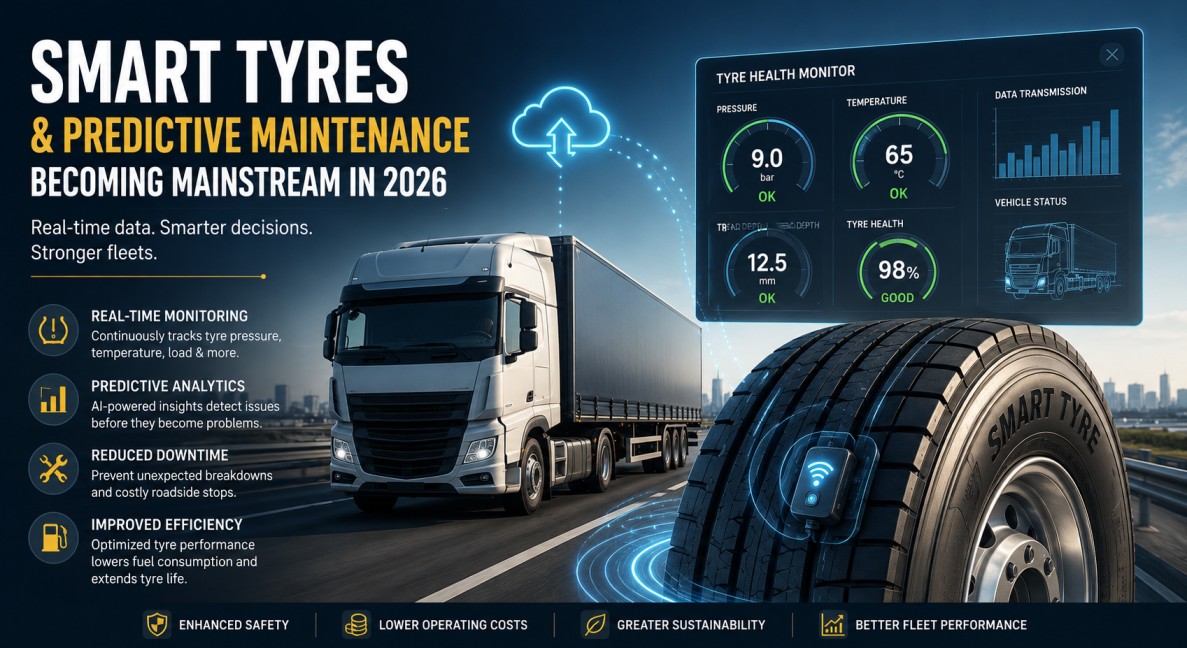
Smart Tyre Market Expected to Exceed $110 Billion by 2026
The global tyre industry is rapidly embracing smart tyre technologies as fleet operators seek greater efficiency, safety, and cost control. Smart tyres equipped with sensors and connected monitoring systems are becoming increasingly common across truck, bus, construction, mining, and industrial fleets. Industry analysts expect adoption to accelerate throughout 2026 as predictive maintenance becomes a key strategy for reducing downtime and maximizing tyre performance.
Market Growth by Numbers
- 2026 market value: Global smart tyre market projected to exceed $110 billion.
- Growth rate: Forecast CAGR estimated at approximately 6.2% over the coming years.
- Fleet adoption: Commercial vehicle operators continue expanding the use of connected tyre monitoring systems.
- Maintenance savings: Predictive maintenance programs help reduce unexpected tyre-related breakdowns.
- Digital integration: Increasing connection between tyre monitoring platforms and fleet telematics systems.
Key Demand Drivers
- Rising operating costs: Fleets seeking improved fuel efficiency and reduced maintenance expenses.
- Downtime reduction: Early fault detection helping prevent costly roadside failures.
- Safety requirements: Greater emphasis on tyre condition monitoring and regulatory compliance.
- Data-driven operations: Fleet managers increasingly relying on real-time performance information.
Technology & Product Trends
- Real-time monitoring: Sensors tracking tyre pressure, temperature, and wear conditions continuously.
- Predictive analytics: AI-powered systems identifying potential tyre failures before they occur.
- Telematics integration: Tyre data being incorporated into broader fleet management platforms.
- Remote diagnostics: Fleet operators monitoring tyre performance across multiple locations.
Industry Impact
- Improved fleet efficiency: Better tyre management helping increase vehicle uptime.
- Extended tyre life: Continuous monitoring supporting optimal tyre maintenance practices.
- Lower fuel consumption: Proper inflation management improving rolling resistance performance.
- Reduced operating costs: Predictive maintenance helping minimize unexpected repair expenses.
Outlook
Smart tyre technology is expected to become an increasingly important component of fleet operations throughout 2026 and beyond. As digitalization expands across transport, construction, and mining sectors, connected tyre systems and predictive maintenance solutions are likely to become standard tools for improving safety, efficiency, and overall fleet performance.